Exhibition: The figure of the Earth. A French-English scientific debate (XVIIᵉ-XXIᵉ century)
Event
Designed by the Académie des Sciences and the Royal Society, with the support of the Mazarine and Institut de France libraries, cthis exhibition traces more than three centuries of debate, experiment and cooperation around a fundamental question: what is the exact shape of the Earth?
Informations pratiques
Location
Institut de France - Mazarine LibraryDate
-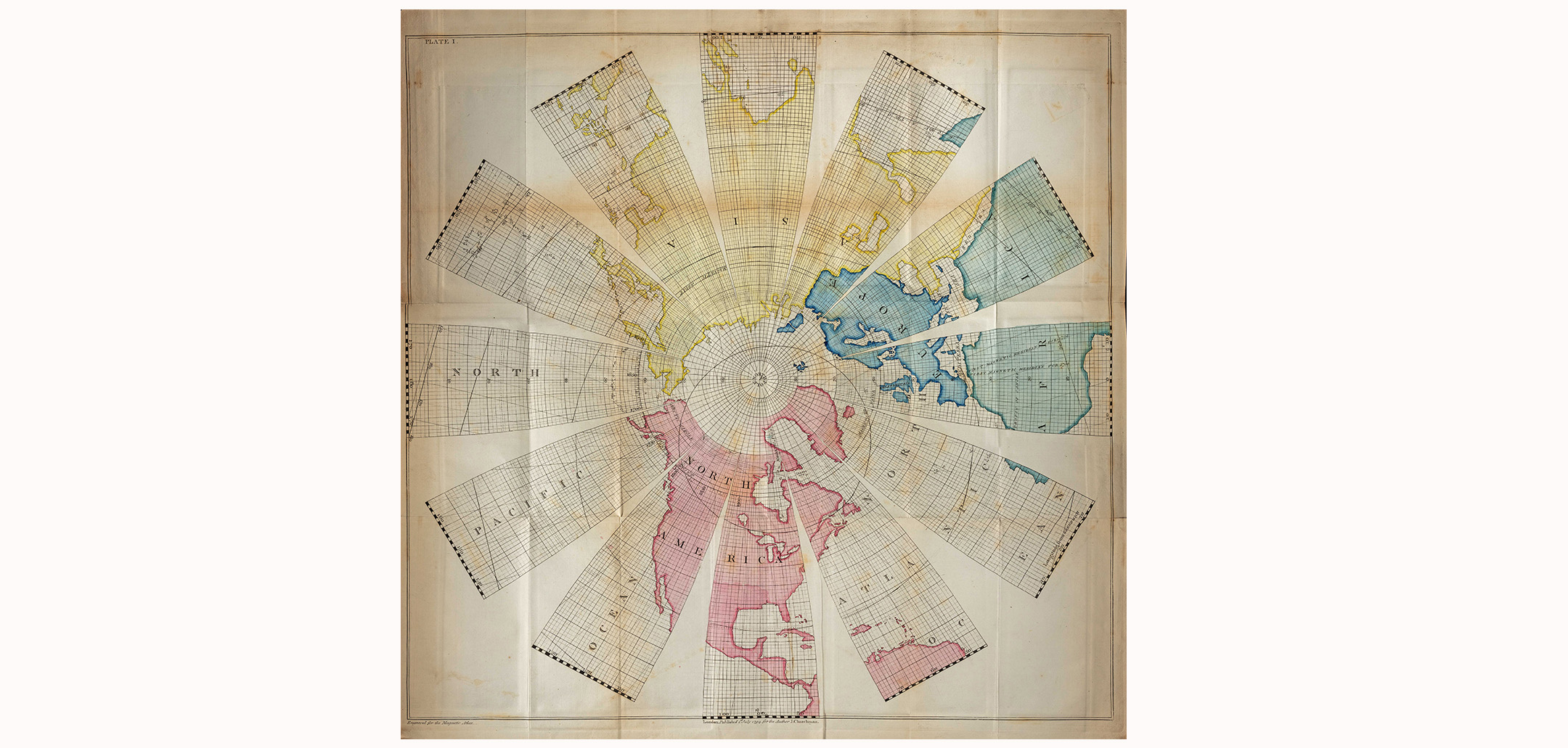
John Churchman, The magnetic atlas; or, Variation charts of the whole terraqueous globe, comprising a system of the variation and dip of the needle, by which, the observations being truly made, the longitude may be ascertained. Plate I. 1794. The Royal Society, RCN 33275
The Académie des Sciences and the Royal Society present, from April 1 to June 20, 2026, the exhibition "La figure de la Terre. Un débat franco-anglais (XVIIe-XXIe siècle)", on the premises of the Bibliothèque Mazarine, in the heart of the Institut de France. Conceived jointly by two of Europe's oldest scientific academies, this exhibition traces more than three centuries of debate, experiment and cooperation around a fundamental question: what is the exact shape of the Earth?
This exhibition offers a historical and scientific journey through more than three centuries of research devoted to measuring, modeling and understanding the shape of our planet, from the 17the century through to the space age. Since ancient times, we've known that the Earth is, broadly speaking, a sphere. The key question was whether it was slightly flattened at the poles or elongated. To answer this question, scientists, astronomers, mathematicians and geodesists have developed theoretical models, designed innovative instruments and conducted vast observation campaigns around the world. The exhibition features exceptional sources drawn mainly from the collections of the Académie des Sciences and the Royal Society, testifying to the intensity of scientific exchanges between Paris and London and the decisive role of international cooperation in the production of knowledge.
.
WHY SHOULD I BE INTERESTED IN THE FIGURE OF THE EARTH?
For Enlightenment scientists, this question primarily answered a powerful desire to understand the world, driven by rationality, curiosity and an ambition for universality. At the end of the 18th century, this intellectual quest led to the creation of a universal, non-arbitrary unit of length measurement, the metre, based on the dimensions of the Earth. But this ambition could not overshadow the political and economic realities of the time. The great scientific expeditions also took place against a backdrop of national rivalries, colonial expansion and military strategies, where mastery of astronomical and geodetic measurements became a stake in power and maritime domination.
.
A EUROPEAN SCIENTIFIC CONTROVERSE
Since the end of the 17the century, the question of the Earth's figure has opposed two conceptions: that defended by Isaac Newton, for whom the Earth is flattened at the poles due to its rotation, and that supported by certain French astronomers, notably Cassini, who, relying on geodetic surveys, favor an elongated Earth.
Published in 1687, the first edition of Newton's Philosophiae naturalis principia mathematica, preserved in the Bibliothèque de l'Institut de France, represents a major turning point in modern science. It introduces the concept of universal gravitation and draws on the emerging tools of differential and integral calculus. In particular, Newton shows that the Earth's rotation must lead to a flattening at the poles, which he attempts to quantify using the measurements available at the time.
Faced with these theoretical developments, the Académie des Sciences embarked on a vast program of experimental verification. The memoirs of Jacques Cassini, Alexis Clairaut and Pierre Louis Moreau de Maupertuis, presented in the exhibition, bear witness to the vigor of scientific debate within the academies.Voltaire summed up this vast debate in 1734 in his Lettres philosophiques, with a formula that has remained famous: "In Paris, you figure the Earth made like a melon; in London, it is flattened on both sides".
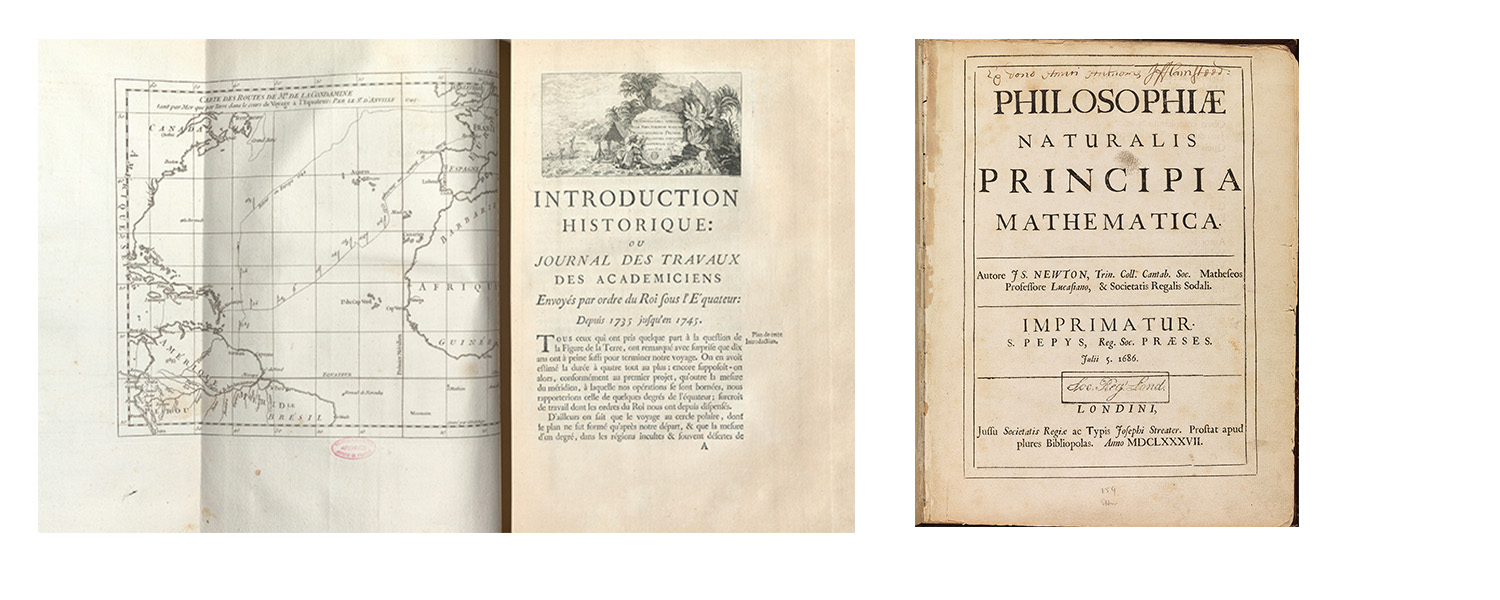
La Condamine, Journal du voyage fait par ordre du Roi à l'Équateur [...], Paris, 1751. © Académie des sciences; Isaac Newton, Principia Mathematica (title page), 1687 © Royal Society
SAVANTS-EXPLORATORS AND GREAT EXPEDitions
The exhibition highlights the exploratory dimension of research. These scientists, also explorers, left observatories and academies to travel to the farthest reaches of the world to measure meridian arcs and confront their theoretical models with the reality of the field.
The geodetic mission to Lapland (1736-1737), led by Pierre Louis Moreau de Maupertuis, is illustrated by manuscripts preserved at the Royal Society, including the letter Maupertuis sent to his London counterparts even before the official publication of his results. These measurements confirm the flattening of the Earth at the poles and help validate Newton's theory of gravitation.
In parallel, the expedition to Peru led by Charles Marie de La Condamine, Pierre Bouguer and Louis Godin is documented by manuscripts, maps and triangulation tables from the archives of the Académie des Sciences. Tables des triangles de la méridienne de Quito or annotated proofs of field diagrams show concretely how data was collected, verified and exploited over several years.
These undertakings were based on collaboration between Spanish officers, French scientists and British correspondents who took part in data collection and analysis. An international collaboration, illustrating its importance as a driver of scientific progress.
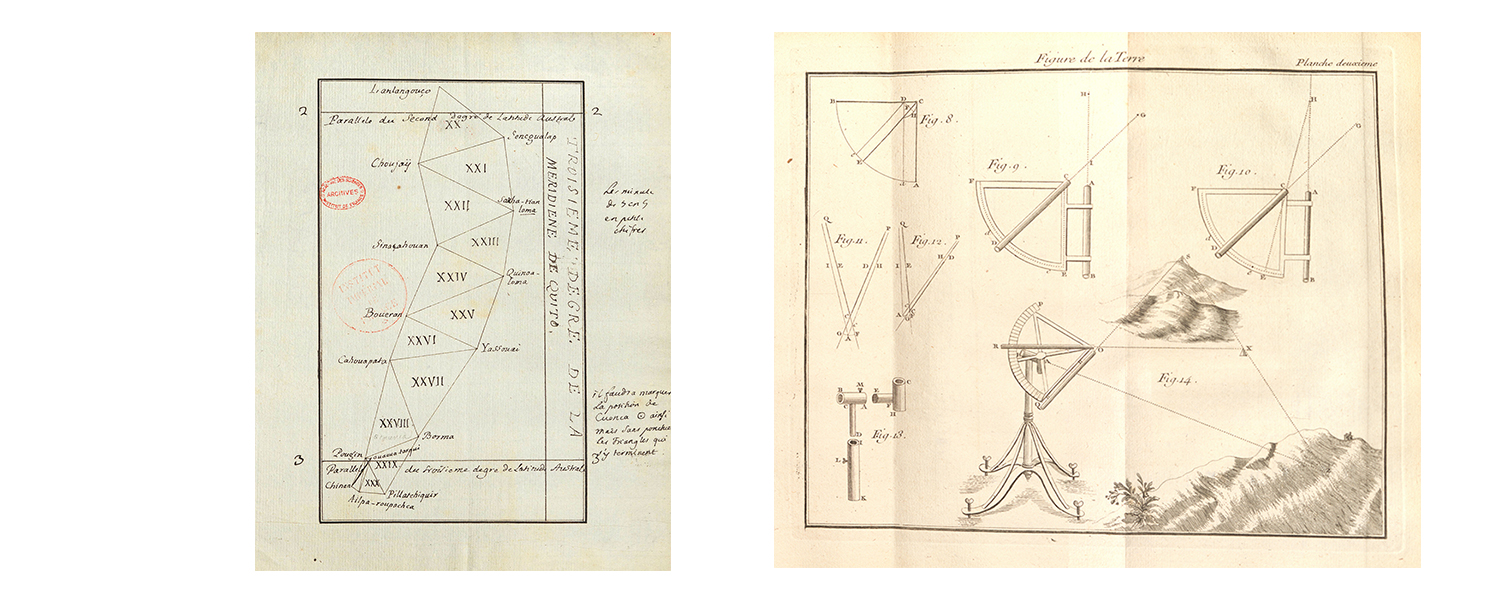
La Condamine, Third degree of the Quito meridian, 1736-1737 © Académie des sciences ; Pierre Bouguer, La figure de la Terre. [...], Paris, 1749 © Académie des sciences
INSTRUMENTS, METHODS AND THE CIRCULATION OF KNOWLEDGE
Beyond the texts, the exhibition presents instruments emblematic of geodesy and astronomy. The pied de roi (the length of Charlemagne's foot) belonging to La Condamine, used as a proportional measuring instrument, and Edward Troughton's azimuth circle, used during the great triangulation of India, embody the materiality of scientific work.
These instruments circulated between countries, as did data and publications. Richard Waller's English translation of Jean Picard's Mesure de la Terre (1688), preserved at the Royal Society, bears witness to the first scholarly exchanges between the two academies and the rapid dissemination of scientific results on a European scale. In this work, Picard presents his triangulation measurement of the length of the Paris meridian by one degree of latitude. From his readings, he determines that the Earth's radius at the equator measures 6328 km, a relative error of 0.8% compared with the value accepted today.
.
CALCULATIONS, MODELS AND THEORETICAL RENEWAL
The observations accumulated over the course of expeditions fed into increasingly sophisticated calculation and modeling work. Alexis Clairaut, for example, in his manuscripts and treatises presented in the exhibition, corrects Newton's hypothesis of a homogeneous Earth by replacing it with a heterogeneous spheroid, thus integrating experimental results with mathematical models. In the XIXe century, Henri Poincaré's work on the equilibrium of a rotating fluid mass subject to gravitation, illustrated by the manuscript of one of the notes he published on the subject in the Comptes rendus hebdomadaires des séances de l'Académie des sciences, proposes a general mathematical framework for forms of equilibrium. In them, Poincaré shows that a rotating fluid mass, which can be compared in certain respects to the Earth, does not necessarily reduce to a simple ellipsoid, opening the way to more complex conceptions of its shape, such as that of a pear.
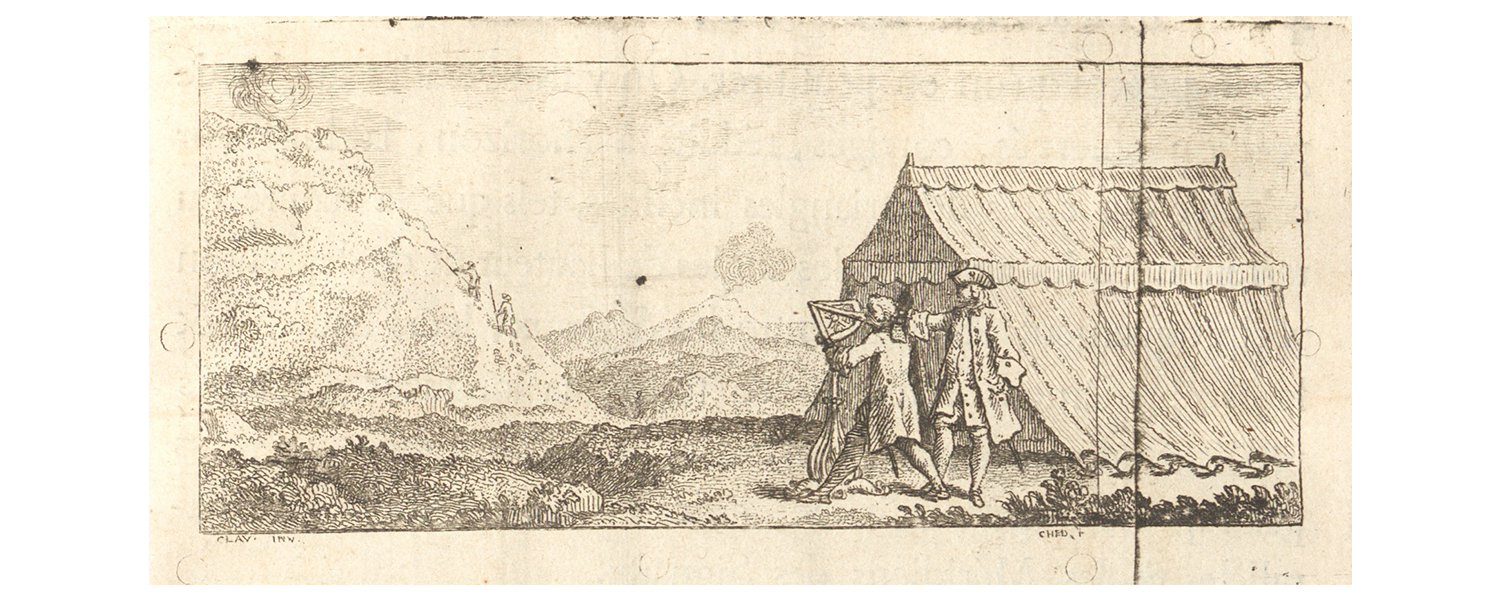
La Condamine. Mesure des trois premiers degrés du méridien dans l'hémisphère austral [...], Paris, 1751. Académie des sciences
FROM TRIANGULATION TO SATELLITES
The tour concludes with contemporary developments, marked by the advent of space technology. The model of Sputnik 1 recalls the decisive role of satellites in refining measurements of the Earth's shape. The work of Anny Cazenave, who helped measure rising sea levels and better understand theEl Niño phenomenon, and whose portraits and publications are presented, shows how satellite altimetry and the study of the gravitational field led to the modern notion of the geoid.
WOMEN OF SCIENCE AND THE CIRCULATION OF IDEAS
The exhibition jointly presents works by Émilie du Châtelet and Mary Somerville. As major translators and commentators on the works of Newton and Laplace, respectively, they played an essential role in the dissemination, understanding and appropriation of scientific theories on a European scale, contributing fully to the intellectual history of the figure of the Earth.
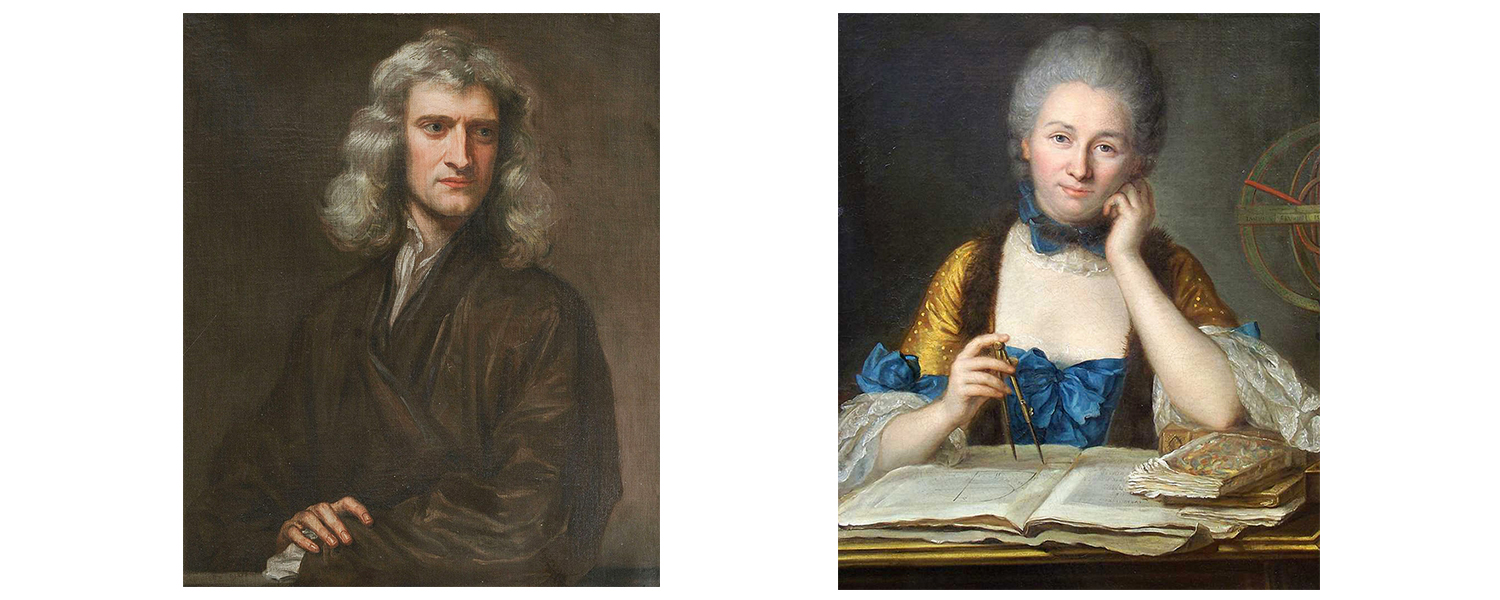
Godfrey Kneller, Portrait of Isaac Newton, 1689, Isaac Newton Institute. © Wikimedia Commons; Maurice-Quentin de La Tour, Mme Du Châtelet at her work table, detail,1763, Private collection. Wikimedia Commons
COOPERATION AND SCIENTIFIC EMULATION
Founded six years apart, the Royal Society in London in 1660 and the Académie des Sciences in Paris in 1666, the two institutions have embodied, for over three and a half centuries, a singular relationship blending intellectual rivalry, mutual admiration and enduring cooperation. Their respective mottos, Nullius in verba ("Take no one's word for it") and Invenit et perficit ("Discover and perfect"), encapsulate the same scientific ideal founded on experiment, demonstration and the continuous improvement of knowledge.
Isaac Newton occupies a central place in this shared history. His demonstration of the Earth's flattening at the poles, set out in Book III of the Principia, constitutes one of the pinnacles of scientific thought. Translated into French by Émilie du Châtelet, this seminal text is featured in the exhibition. Newton, the first foreign member of the Académie des Sciences elected in 1699, was the embodiment of mutual recognition between the two scientific communities. Since then, nearly 190 British scientists have been elected to the Academy, testifying to the depth and continuity of these exchanges.
From Newton to Poincaré, via Maupertuis, Clairaut or Maclaurin, the exchanges, debates and mutual esteem between French and British scientists have shaped a shared scientific history, which this exhibition brings to light. The history of the figure of the Earth thus reminds us that science progresses at the crossroads of intellectual, technical and geopolitical motivations, a tension that is still relevant today, and which this exhibition invites us to question.
A unique event, between heritage, nature and scientific knowledge, for all enthusiasts, students and teachers.
Exhibition curatorship
Julien Pomart, Académie des sciences, Archives Manager & Dr Louisiane Ferlier, The Royal Society, Centre for the History of Science, Digital Resources Manager
Useful links
Royal Society/Académie des Sciences exhibition, London, 2024:
[Exhibit: Figuring the Earth - perspectives from the Académie des Sciences and the Royal Society]
Practical information
Mazarine Library, from April 1er to June 20, 2026
The Library is open Monday to Saturday from 10am to 6pm, closed on public holidays, as well as on April 6, May 14, May 25.
Exhibition access limited to 10am-1pm on Institute public session days: May 20, June 2.
The Bibliothèque Mazarine reading room, served by a 44-step staircase, is not accessible to people with reduced mobility.
Around the exhibition
Guided tours on Wednesdays, by reservation (information to come)
Archives of the Academy of Sciences
Mazarine & Institut de France libraries
An exhibition organized by the Académie des Sciences and the Royal Society, with the support of the Mazarine and Institut de France libraries.